

Have more questions?
Our retirement matching tool can help match you with vetted fiduciary financial advisors. You can
receive your matches and schedule an introductory call for free!
â€
In just a few
minutes
1. Answer a few questions.
2. Match with vetted fiduciary financial advisors
free!

Helping people make smart financial decisions
What Strategies Can Help Reduce My RMD Tax Burden After Age 73?
This Free Quiz Finds Vetted Fiduciary Advisors Who May Be Able to Help
Take Matching Quiz
Find financial advisors who serve your area, free!
In the press:


Turning 73 can be considered a key milestone for retirement planning: It’s the year required minimum
distributions (RMDs) go into effect for most.
This means you’ll need to start drawing down your balances from tax-deferred retirement accounts like
401(k)s and IRAs.
Since RMDs count as taxable income, they have the potential to trigger significant tax bills. But with
thoughtful strategies, you may be able to reduce the RMD tax burden and help preserve more of your
hard-earned wealth.
Consulting a fiduciary financial advisor
can be a great first step to factoring RMDs, and the potential tax repercussions, into your retirement plan.
A 2023 Northwestern Mutual study found that 66% of U.S. adults admit their financial planning needs
improvement. However, only 37% of Americans work with a financial advisor.1
In fact, SmartAsset’s latest proprietary model reveals that
working with a financial advisor
could potentially add from 36% to 212% more dollar value to investors’ portfolios over a lifetime, depending
on multiple unique, individual factors.2
Net worth from age 45 to 77
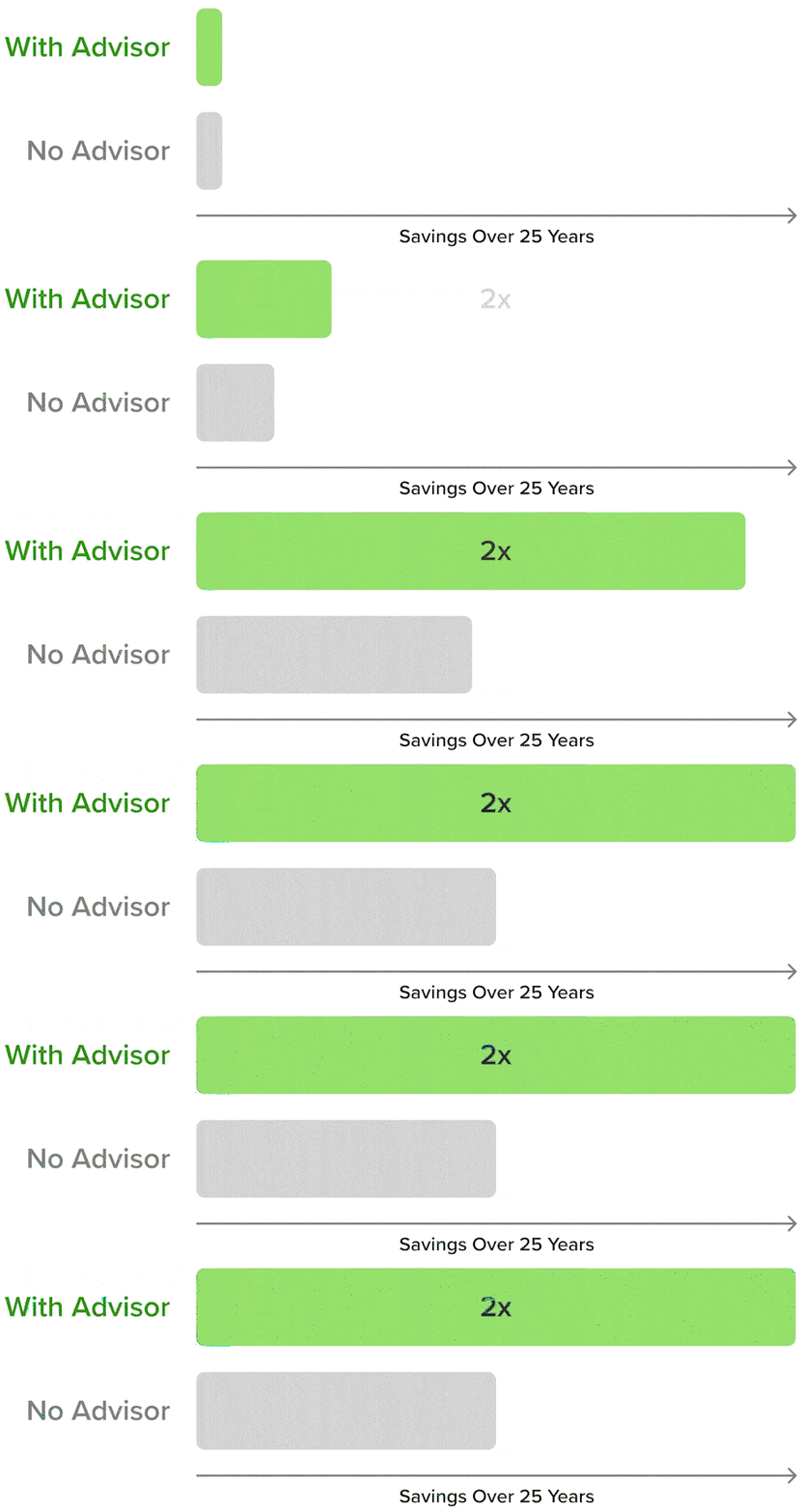
Final lifetime net worth with and without a financial advisor.
Disclaimer: This example demonstrates the potential final lifetime portfolio value, accounting for estimated investment returns, tax savings and inflation over different life stages for an individual starting with $500,000 at age 45, through age 77. Under a set of core assumptions, this consumer profile is projected to have a final lifetime portfolio value of approximately $3.24 million if retaining the services of a financial advisor – not accounting for additional savings or portfolio withdrawals – versus a final estimated lifetime portfolio value of $1.56 million without the services of a financial advisor. This example is based on the valuation framework presented in SmartAsset's whitepaper “The Value of a Financial Advisor: What's It Really Worth?” (Nov. 2024). The value of professional financial advice is only an illustrative estimate and varies with each unique client's individual circumstances and portfolio composition. Carefully consider your investment objectives, risk factors, and perform your own due diligence before choosing a financial advisor.
Disclaimer: This example demonstrates the potential final lifetime portfolio value, accounting for estimated investment returns, tax savings and inflation over different life stages for an individual starting with $500,000 at age 45, through age 77. Under a set of core assumptions, this consumer profile is projected to have a final lifetime portfolio value of approximately $3.24 million if retaining the services of a financial advisor – not accounting for additional savings or portfolio withdrawals – versus a final estimated lifetime portfolio value of $1.56 million without the services of a financial advisor. This example is based on the valuation framework presented in SmartAsset's whitepaper “The Value of a Financial Advisor: What's It Really Worth?” (Nov. 2024). The value of professional financial advice is only an illustrative estimate and varies with each unique client's individual circumstances and portfolio composition. Carefully consider your investment objectives, risk factors, and perform your own due diligence before choosing a financial advisor.
Interested in finding a financial advisor? SmartAsset's
no-cost tool
can help you find and compare vetted fiduciary advisors in just a few minutes. How does the free tool work?
It's easy:

Short questionnaire takes just a few minutes

Match with vetted fiduciary financial advisors

Compare your matches and choose the one you feel is best for you
The fiduciary financial advisors you match with serve your area and are legally bound to work in your best
interest. You may even be able to instantly connect with an advisor for a free introductory call. Advisors
are vetted through our proprietary due diligence process.
5 Ways to Potentially Reduce RMD Taxes After Age 73
Here are five actionable strategies to consider when managing RMD-related taxes:
1. Convert Traditional IRA Funds to a Roth IRA
Roth IRAs are not subject to RMDs, making them a potentially powerful tool for reducing your taxable income
in retirement.
By converting portions of your traditional IRA to a Roth IRA over time, you may be able to lower the overall
balance of accounts subject to RMDs.
For example, at age 73, you might consider converting a portion of your IRA during a year when your other
income is limited, such as after completing a major home sale or other large expense.
Keep in mind that Roth conversions are taxable in the year they occur, so it can be important to calculate
the potential tax impact ahead of time.
A fiduciary financial advisor may be able to help with this. You can get matched with advisors at no cost by
clicking here and taking a short survey.
2. Make Qualified Charitable Distributions (QCDs)
If you’re feeling generous, qualified charitable distributions (QCDs) may help offer a dual benefit:
supporting causes you care about while reducing your taxable income.
A QCD allows you to transfer up to $100,000 per year directly from your IRA to a qualified charity.
For example, a 74-year-old who has already fulfilled their personal financial needs might use a QCD to
donate part or all of their RMD to a favorite charity, which could help ensure it doesn’t potentially
increase their taxable income.
This strategy has the potential to be particularly effective for reducing taxes without increasing your
adjusted gross income (AGI), which can impact other tax factors like Medicare premiums.
3. Strategically Withdraw to Manage Future RMDs
For individuals already past 73, strategically withdrawing more from tax-deferred accounts may be able to
help manage future RMDs by reducing their size and potential tax impact.
This approach involves taking distributions to stay within lower tax brackets, preventing larger RMDs in
later years.
For example, a 74-year-old might withdraw extra funds to cover anticipated expenses or reinvest in a taxable
account, maintaining control over their taxable income.
Proactive planning can potentially help you avoid unnecessary tax spikes while meeting your financial needs.
A fiduciary financial advisor could help you determine if this is a smart strategy for you.
Click here to take SmartAsset’s quick, free quiz
to get matched with advisors who serve your area.
4. Adjust Your Investment Allocation
The mix of assets in your retirement accounts has the potential to influence the growth of your balances and
impact the size of your RMDs.
Shifting to investments that generate lower returns in tax-deferred accounts and higher returns in taxable
or tax-free accounts may help manage the potential growth of RMD-triggering accounts.
For example, a 73-year-old might prioritize holding income-generating bonds in their IRA while keeping
growth-focused stocks in their Roth IRA, potentially keeping the traditional IRA from growing to a point
that it inflates future RMDs.
Always consider your overall financial goals and risk tolerance before making changes to your portfolio.
This is another area where a
financial advisor
may be able to help.
5. Use RMDs to Pay for Qualified Expenses
At age 73 and beyond, leveraging RMD funds strategically for essential expenses could potentially help
reduce the need to dip into other taxable accounts.
For example, you could use RMD funds to pay for qualified medical expenses, home modifications, or even
long-term care premiums. If these costs exceed a certain percentage of your AGI, they may also provide
potential tax deductions.
This approach could allow your RMDs to be used effectively while potentially offsetting their tax impact.

How to Get Help Planning for RMDs
While required minimum distributions are unavoidable, you have options to mitigate their tax impact. By
taking proactive steps like Roth conversions, charitable giving, or strategic withdrawals, you may position
yourself for a more tax-efficient retirement.
If you're unsure about handling your RMDs, that’s where a
fiduciary financial advisor
can be invaluable.
Fiduciaries may be able to help you understand your options when it comes to planning for RMDs and
minimizing your tax liability. Additionally, any conflicts of interest must be disclosed, and fiduciaries
are obligated to work in your best interest.
Finding a fiduciary shouldn't be that hard. Thankfully, now it isn't.
SmartAsset’s free matching quiz
can match you with fiduciary advisors who serve your area. From there, you can compare and decide which
advisor to work with. All advisors on the matching platform have been vetted through our proprietary due
diligence process.
The quiz
takes just a few minutes, and in many cases, you can be connected instantly with an advisor to have an
introductory call.
Click Your State to Get Matched With Financial Advisors Who Serve Your Area
After you choose your state and answer a few questions, you can compare up to three advisors that serve your
area and decide which to work with.
Find a Financial Advisor
Find financial advisors who serve your area, free!